FAQ
1. How do I get started with the Kurier API?
- Refer to our tutorial here: Tutorial
- API document: https://api-testnet.kurier.xyz/docs
- Testnet API URL: https://api-testnet.kurier.xyz/api/v1
2. What are the chain ID mappings?
Chain ID mappings can be found here: Supported Networks
3. What are common issues why proof verification would fail and how do I resolve this?
- Most of the common errors are due to incorrect structure and formatting required for the proof type that a user is trying to submit. Check that your code is properly submitting the correct requested field based on one of the supported proof types and versions.
- All proof submissions require the following fields:
proofData,proofType, andvkRegistered. WithinproofDatathe fieldsproofandvkare also required. - For requirements for each proof type, refer here: Supported Proofs.
vkRegistereddetermines what you put inproofData.vk:vkRegistered: false->proofData.vkmust contain the full verification key.vkRegistered: true->proofData.vkmust contain a previously returnedvkHashfrom/register-vk.
- Why this matters: using
vkRegistered: trueafter registration avoids resending the full VK on every request, which lowers verification cost for repeated submissions.
4. How do I check if my attestation is published?
The chain ID needs to be defined when calling the submit-proof endpoint. After the attestation is published, the job status will be updated to “Aggregated”. The job status and the aggregation details can be found from the /job-status endpoint.
- Option 1, verify via smart contract: https://docs.zkverify.io/overview/getting-started/smart-contract
- Option 2, use the block explorer and enter in the aggregation details in the verifyProofAggregation method on the smart contract. Example on Horizen L3 Base: https://horizen-explorer-testnet.appchain.base.org/address/0x201B6ba8EA862d83AAA03CFbaC962890c7a4d195?tab=read_write_proxy
- Example: Required values can be found from the
/job-statusendpoint
curl -X GET "https://api-testnet.kurier.xyz/api/v1/job-status/{apiKey}/6fb39e27-ab7c-11f0-a9f5-2ed83da2b73c" \
  -H "Content-Type: application/json"
{
  "jobId": "6fb39e27-ab7c-11f0-a9f5-2ed83da2b73c",
  "status": "Aggregated",
  "statusId": 6,
  "proofType": "groth16",
  "chainId": 845320009,
  "createdAt": "2025-10-17T17:12:19.000Z",
  "updatedAt": "2025-10-17T17:13:04.000Z",
  "txHash": "0xf5c81f4896c980224ae8c7f6852f9b27c5869da896141782065f5c71388b06dd",
  "blockHash": "0xb8fe72aef6b4ac0cff5702ced59eb8e2d147c57c1267d3d7b89eb1bcd944e120",
  "aggregationId": 18555,
  "statement": "0x6ba0adac9febf7a8cdbef31b5e1799af9557784b41a7f46af94ab9dbecf37081",
  "aggregationDetails": {
    "receipt": "0x24f5a00876d55fc142846e17b41540fc9aa4c223d53fdd8f5b77f79627d2adc2",
    "receiptBlockHash": "0x90435b1c565e832010c684670ae8d17c520820b469abb4a6d0ced566e18c63ce",
    "root": "0x24f5a00876d55fc142846e17b41540fc9aa4c223d53fdd8f5b77f79627d2adc2",
    "leaf": "0x6ba0adac9febf7a8cdbef31b5e1799af9557784b41a7f46af94ab9dbecf37081",
    "leafIndex": 7,
    "numberOfLeaves": 8,
    "merkleProof": [
      "0xc59014864835a71d88385ffe9f6321626818c19df1fa1c2b52a6ab5a62ca4467",
      "0x8612679ddadc54ee066d1eaed079dcfc5a02c383f5e0782a6b85d765d13554a5",
      "0x8f41f883c53b1e1b7cb1ba58450374f538a534ecfbdc2092e8c5158d1d9ec279"
    ]
  }
}
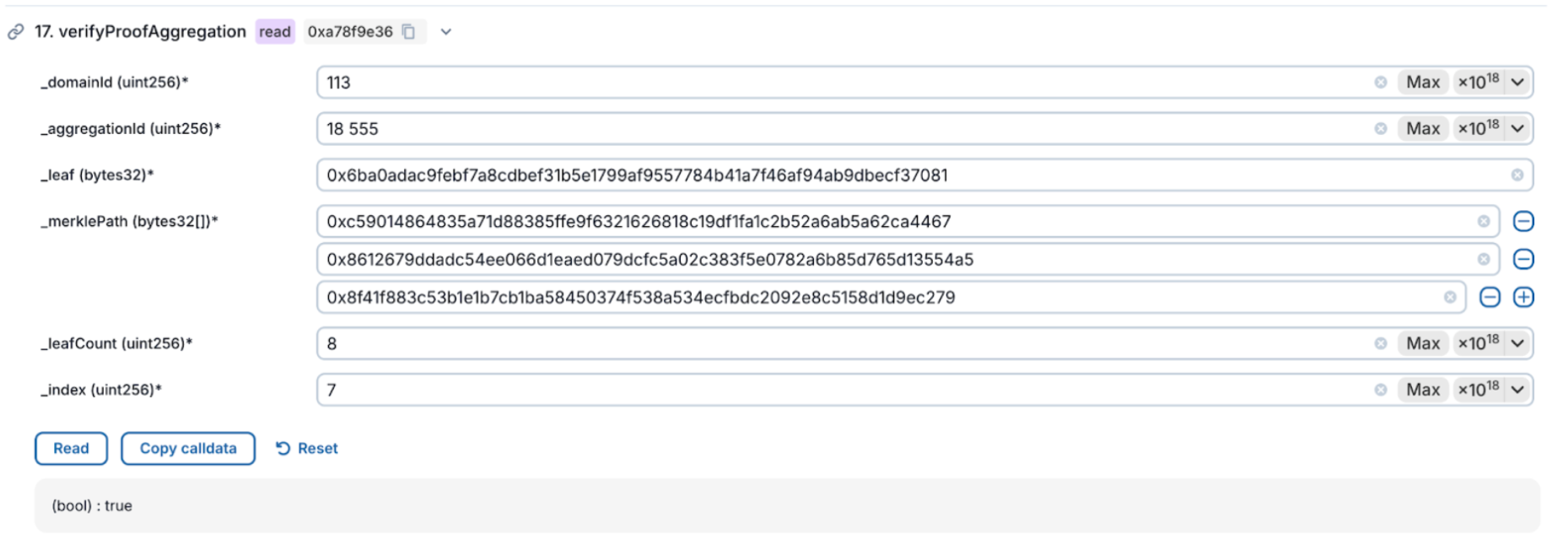
On the attestation contract, use the verifyProofAggregation method. It will return true if the attestation was successful:
5. How long does it take for an aggregation to finalize?
Aggregation timing depends on the chain you’re targeting. Each chain collects a batch of proofs, and an aggregation happens either when the batch fills up or when a set amount of time passes, whichever comes first. While the exact timing can vary based on how many proofs are submitted, aggregations for each chain will occur at most at the intervals listed below:
| Network | Chain | Time |
|---|---|---|
| Testnet | Ethereum Sepolia | 2 mins |
| Testnet | Base Sepolia | 6 hours |
| Testnet | Optimism Sepolia | 6 hours |
| Testnet | Arbitrum Sepolia | 6 hours |
| Testnet | EDU Chain | 6 hours |
| Testnet | Horizen Testnet | 2 mins |
6. How do I register my verification key?
First, ensure your proof matches one of the supported proof formats (for example, do not submit ultrahonk when your circuit output is ultraplonk).
Then use POST /register-vk/{apiKey} once for a given verification key. The response returns a vkHash you can reuse in future submit-proof calls with vkRegistered: true.
If you do not register the key, submit with vkRegistered: false and include the full key in proofData.vk.
7. How do I get an API key?
- Testnet: Sign up here https://testnet.kurier.xyz
8. How do I check transactions on zkVerify?
- For transactions submitted on testnet, you can use the transaction hash in the block explorer here: https://zkverify-testnet.subscan.io